I grew up in a small city in Brazil in the 90s, and got my first computer in 1998 during my teenage years (a 586 if you're curious). Piracy of software felt integrated into the experience of having a computer. No online stores or cloud subscriptions! Just weird "computer technicians" who took care of your computer, which included installing more utilities. Pirated, cracked software, that is. Can you imagine that it was common to leave technicians unattended while they fixed your computer?
I had no idea what a file system was. A time of dial-up internet, learning to code mIRC scripts, and trying to build search engines and dumb chatbots with friends who were a lot smarter than me. Walking the streets with Western Digital hard drives in my backpack, always ready to continue projects in a friend's home.
Fast-forwarding to 2026, after a 15-year career in tech, including building VR/AR experiences for 5 years at Meta Reality Labs, I now explore, design and ship software with the assistance of LLMs. What do these periods of my computer-life experience have to do with each other, and what do they suggest about the hidden parts of software that resist being copied?
Software was originally a physical thing, similar to books, VHS and records. Over the years it shifted into a service you rent for a monthly fee, from pure utility to complex workflows and branded user experiences. Terminologies like freeware and shareware faded along the way.
Maybe it is time to bring the "ware" back and start calling outputs from large language models LLMware? Most importantly: are today's LLMs able to see into deeper levels of complexity (the soul of software?) when asked to clone an existing application?
—
I prompted Claude Code to get inspired by and build a working version of Ulysses (yes, the writing app), which I have never used in depth. I do know that it's craft-driven and opinionated software. A product that goes beyond being just a text editor.
So what does an LLM actually produce when it gets inspired by existing software in March 2026, before the Fable and Astra models?
It took about 5 minutes for Claude Code to build the app. I'm not a real software engineer! I'm a designer who codes, and side code projects would usually take me 1-3 months of googling and mashing up pieces of code together. I can't properly wash my dishes in 5 minutes!
BUT, did it work on the first launch? Almost! It had one major bug: the goal setting was chosen to be a blocking onboarding step, and it didn't work, so the core mechanic (writing) wasn't possible at all. Perhaps that's a testament to the fact that LLMs can be really dumb, but so can humans (right?!). Another 30s task and we had a working standalone Electron Mac application.
How close did we get to Ulysses? For someone without experience, it may look like most of the utility of Ulysses is there. Maybe that's because the core mechanic (writing) was there. I could create, write and save markdown documents. But looking closely, it was clear it lacked project organization depth (projects and groups), had no export or publishing capabilities and had no dashboard, which is a core concept for Ulysses, aggregating progress, outline, annotations and revision capabilities.
And so I kept building because “why not take this somewhere else?” Local LLMs are more accessible (lighter, faster, smarter, even on MacBooks!). So, I started to evolve the clone into something I would enjoy writing on and that could push me to finish drafts.
Tasks were now taking 5 hours instead of 5 minutes, hitting me in the face with the hidden complexity needed to integrate a local LLM into an app. My first instinct was to rely on the newish Apple Intelligence local models, which would enable macOS and iPadOS apps and “Apple level” of privacy and quality. It led me to a 2-week sprint to create a custom benchmark engine to evaluate different local LLMs and decide which one to use based on how good the critique was and the time it took to warm up. And sadly concluding that Apple's small models weren't great, eventually leading me to go with Gemma4.
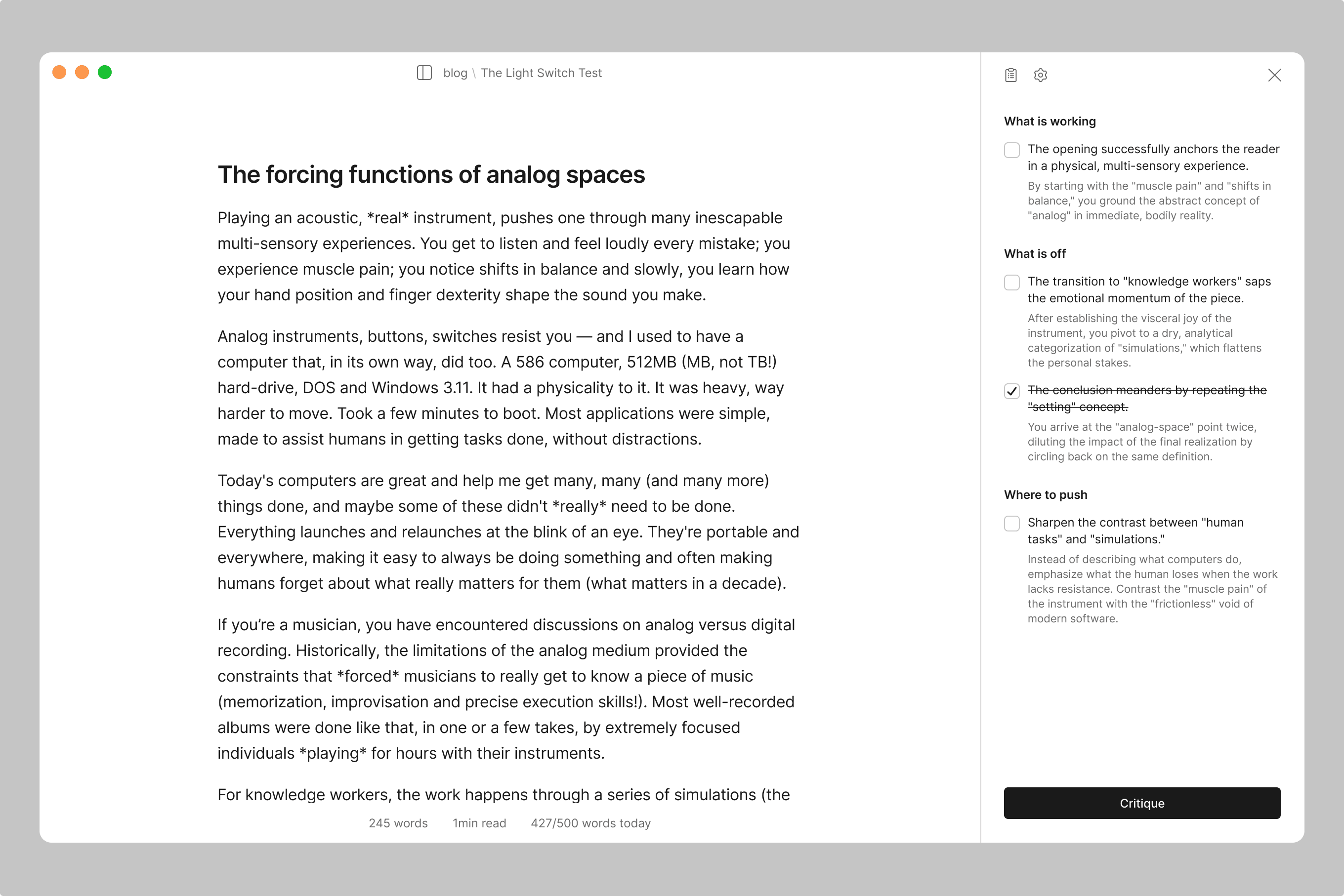
What about the ethics of doing this? It feels weird! AI companies are worried about financial hacking and biological weapons and don't seem to care about the capability of cloning existing software. Is that soft proof that LLMware won't disrupt the bigger players of software? Models should at least refuse prompts mentioning popular software. Suno (“Claude Code“ for music) blocks direct use of famous artist and band names, which forces people to think about how to describe certain styles.
—
LLMware are a form of compression, perhaps comparable to low-quality audio. Most people don't perceive the difference between a low-bitrate MP3 played over a mobile phone speaker and a FLAC file through KEF speakers in a proper listening room. They also introduce new modalities of piracy, with rapid reconstruction of workflows, user experiences and interaction philosophy. No app resists being copied, but it needs to be perceived first, and this level of perception may be uniquely human.
Will modern software become local, non-public by default? And most importantly, should I pay for Ulysses now that I've made a worse version of it for free? I continue to walk around the city with a hard drive, now in my pocket and a bit more powerful, disguised as a phone. And maybe, in a not-so-distant future, we will all be walking with tiny local LLM devices in our pockets to use whenever we need.
—
If you're into writing, I encourage you giving Urca a try.